
Introduction: The Secret of Lead
Lead is the most common metal in our lives but it possesses the air of mystery that makes scientists and curious individuals eager to discover it. The question that people ask is lead magnetic? Although this substance is contained in ordinary objects such as batteries, pipes and radiation shields not many people know about its unusual physical characteristics. This aspect is not new as it was practiced in ancient times and was used in many practical applications. Lead still remains crucial in the industrial scientific and technological sectors in the contemporary world. This paper will delve into the science behind the magnetic behavior of lead, explain why it is a diamagnetic element its everyday uses in the world and some interesting facts that make this element really magnificent.
What is lead?
Lead is a soft, malleable, and dense metallic element with the atomic number Pb and is denoted as lead. It weighs more than most of the common metals hence it can be useful in weight and stability applications. In the past, Romans and other ancient civilizations extensively utilized lead in plumbing buildings and even in wine containers with no knowledge of its poisonous impact. Lead is currently being used in electronics in batteries, radiation shielding alloys and solder. It is suitable because of its corrosion resistance and high density. It is a common type of substance but not many know about its peculiarities in terms of physical and chemical characteristics. Learning about the nature of lead, its response to magnetic fields and so forth may contribute to a clearer picture of the way lead acts as it does and emphasize its significance in the past and present.
Is Lead Magnetic?
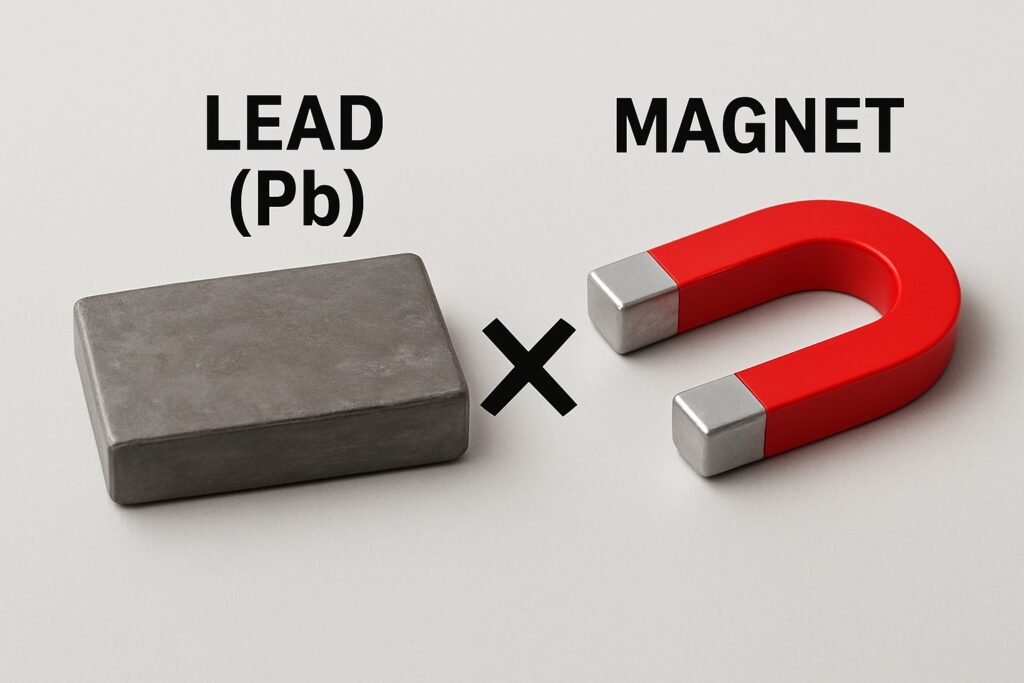
The most frequently asked questions about lead include whether it is magnetic or not. The simple but scientifically curious answer is the following lead is not a magnet. Lead is also a member of the so-called diamagnetic materials i.e. weak repelling magnets unlike ferromagnetic metals like iron cobalt and nickel which are strongly attracted to magnets. The repulsion is very small and this fact cannot be observed in everyday life. Thus, a magnet will not stick or display strong attraction to a piece of lead should you bring it near it. This special property allows lead to be used in situations where the magnetic interference must be avoided and also distinguishes it as compared to most of the metals that are usually thought to be magnetic due to common experience.
The Science Behind Lead’s Diamagnetism
The diamagnetic nature of lead is based on the electron structure of lead. All electrons in a diamagnetic material are coupled resulting in zero magnetic moment. The electrons cause microscopic opposing currents when subjected to a magnetic field which repel each other delivering a weak repulsing effect and prevents a metal object being drawn to a magnet. In contrast to ferromagnetic metals unpaired electrons in lead associate themselves with magnetic fields, which is not possible because of the atomic structure used by the material. This inherent aspect is the reason why the influence of magnets on lead is not noticeable in ordinary circumstances. This principle has been applied by scientists to determine the behaviour of different components within the magnetic fields and it is also applied by engineers to come up with devices and materials that cannot be magnetic in sensitive areas including labs and electronic boards.
Real-Life Implications
The non-magnetic property of lead has a number of practical implications in the day to day activities and in industrial uses. Lead is a good radiation shielding material since it prevents the entry of dangerous X-rays or gamma rays but does not affect the magnetic instruments. Lead-based solder is an extensive application in electronics since it is non-magnetic and devices are not subjected to instability and dysfunction. Scientific studies and industrial machinery have found the diamagnetism of lead to be very useful in averting the undesired magnetic interactions that can cause delicate operations to be disrupted. In other pastimes, such as model building or metalworking, it is possible to work safely and more accurately as one knows that lead is non-magnetic. Its density, softness and diamagnetism make it very versatile which makes it applicable to a broad spectrum of practical and technological applications without any possible complexities of magnetism.
Fun Facts About Lead
Lead is a very interesting element having some striking characteristics in addition to the fact that it is non-magnetic. Although it is thick and poisonous when swallowed it is pliable so that it may be cut with a knife and shaped into different forms. It has a specific magnetic quality of diamagnetism that enables its use in the areas of magnetic-sensitive equipment without any harm. In ancient periods lead was a very important commodity in human civilisation, it was used in plumbing systems, food and beverage containers. Nowadays, it is still relevant in batteries, radiation shields and alloys. The combination of softness density , corrosion resistance and non-magnetic properties make lead a unique element, which still attracts the attention of scientists, engineers and other curious people and lies between the past and modern technology.