
Introduction — The Hidden Story Behind Electric Current
In this article we learn about current and electricity isn’t all about wires and glowing lightbulbs—it is a magical river of power coursing through hidden channels. But how does it happen that this invisible current can really flow in a conductor? It’s all about a potent concept known as current density—the actual lifeblood of electrical flow. It doesn’t only tell us how much current is flowing but also how effectively it does so in any part of the wire. From the red-hot wire that powers our smartphones to the massive power grid, understanding current density gives you a peek into the real science behind how electricity moves around—a secret most people don’t even notice but which is used by every engineer on the planet.
What is Current Density?
The quantity of electric current passing
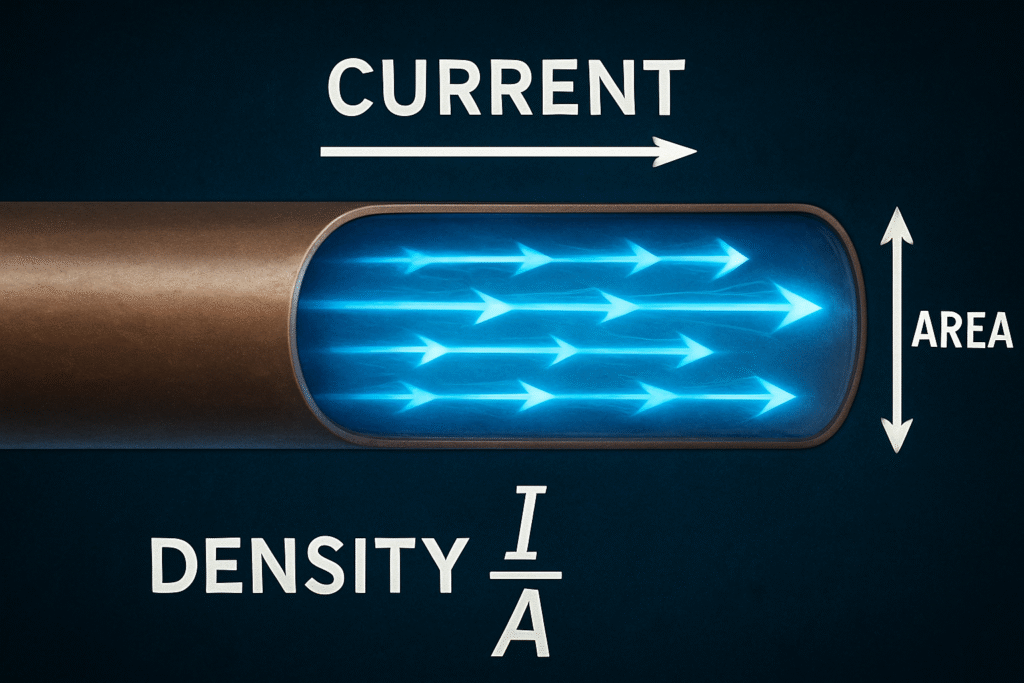
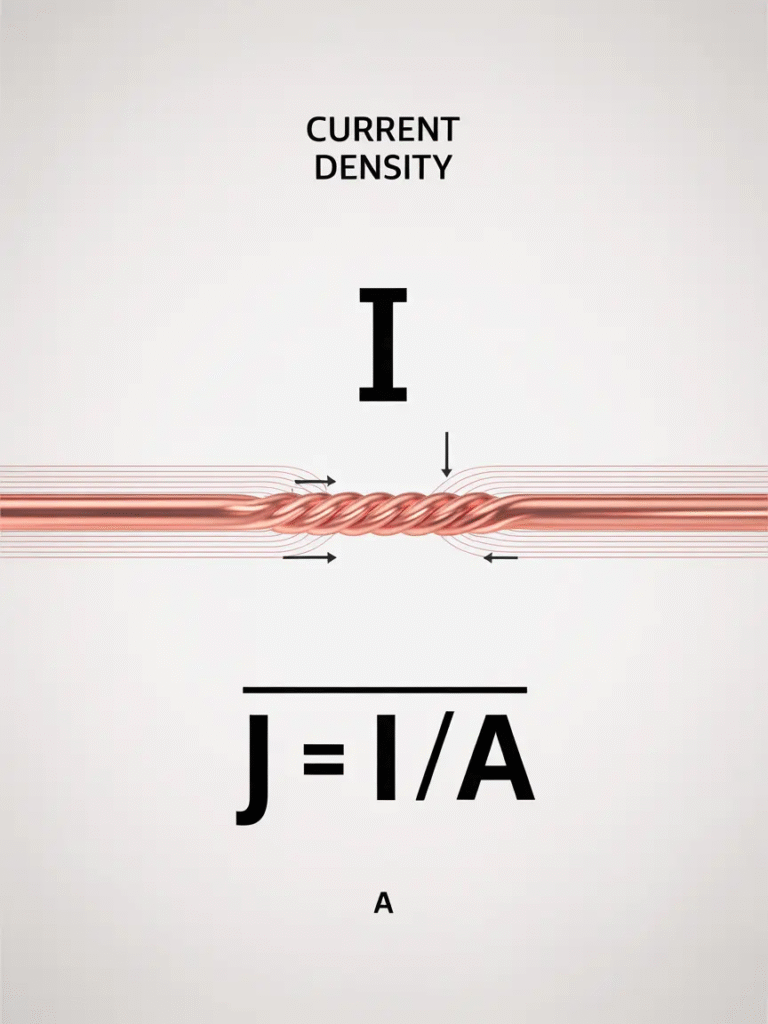
through an area of a conductor is measured by the figure known as the current density. To put it simply it is a description of the amount of current flowing through a unit patch of a material or wire. It is denoted J and mathematically computed as J = I/A with I being the current per amperes and A being the cross-sectional area expressed in square meters. The unit of current density of the SI is amperes per square meter (A/m2). This principle assists us to appreciate the power of flowing electricity as well as its consistency in various sections of a conductor. The greater the density of the current the greater the concentration of the flow of charge that is the greater the amount of heat the greater the amount of energy and the greater the electrical activity in that area.
Factors Affecting Current Density
The value of current density in a conductor is determined by several factors which dictate how effectively electric current can be conducted through a conductor.
- Cross-Sectional Area: This is a significant factor. When the area is smaller the amount of space available to the flow of current is also smaller and thus the level of current in the area is increased whereas when the area is larger the current level decreases.
- Material Conductivity: The higher the electrical conductivity of the material such as copper and silver the freer the electrons will travel resulting in low resistance and a uniform density of a current. Poor conductors in their turn limit the flow of the electrons and augment the density of current in constrained areas.
- Temperature: As temperature increases the resistance of most conductors rises and this lowers the flow of current and changes the current density.
- Applied Voltage: The higher the voltage the more charge will be propelled through a conductor and therefore the total current and thus the current density.
- Conductor Length: The longer the conductors the higher the resistance and this may lower the total current flowing and also alter the current distribution within the conductor.
Current Density in Conductors & Circuits
Current density in circuits and electrical conductors defines the distribution of electric charges in the material. The electric current begins to flow through the conductor when an electric field is forced into the conductor. The current density (J) is an indication of the strength of the flow of this current in a given direction and at a given area. In metals such as copper electrons flow is nearly uniform, that is the distribution of the current is uniform throughout the wire. The current density can however be different at different points in a complex circuit or in a material of varying resistance. This difference may cause hot spots loss of energy or even destruction in case the current is too strong. The concept of current density can enable an engineer to come up with circuit designs that do not overheat due to excessive current and that all parts are functioning as expected
Applications of Current Density
Current density is an important aspect in virtually all electrical and electronic engineering disciplines. It assists a circuit designer to decide on the best thickness of wire to avoid heating and wastage of energy. In semiconductor devices, including diodes and transistors the current density is a controlled value that guarantees reliable operation and eliminates damage of a component by overcurrent. Current density is another factor in battery technology as excessive current density may lower the battery life or lead to thermal problems whereas a sensible range leads to greater efficiency and faster charging. Under electroplating and electrolysis the density of current determines the uniformity of the dispersal of metal ions on surfaces which influences the quality of the coating on the end. In the power transmission lines even load distribution and losses reduction is facilitated by the knowledge of the current density. Concisely everywhere in small packages (microchips) to large power systems (power grids) current density is the unspoken determinant of the performance safety and efficiency of electrical systems.
Challenges & Future Perspective
Current density being important in the study of electricity causes numerous challenges in real world systems. Electrical overheating and energy wastage with irrecoverable damages to electrical components may take place with high current density. In microelectronics it becomes more difficult to stabilize current flow due to the reduction in the sizes of circuits. To deal with this stress engineers should come up with superior material and cooling techniques. In the future scientists are considering superconductors graphene and nanomaterials to conduct bigger currents with more efficiency. Such innovations would reduce resistance and enhance durability and smarter faster more energy efficient electrical technologies of the next generation of devices and power systems.
Conclusion — Understanding Electricity Beyond Just Current
The idea of current density is not only a scientific term but it is the point to the real description of how electricity actually flows. It determines the power movement and effectiveness of electric current in both simple and highly advanced methods among conductors. Both material conductivity and temperature are some of the factors that determine the behaviour of current in real systems. Its use is applied in circuits, batteries and power grids which demonstrates its essential use in contemporary technology. In spite of such problems as overheating and instability the further development of materials and design ensures safer, faster and more efficient electrical systems. The art of the present density is to get to know the actual science of electricity itself.

